Tutorial: Electric vehicle range on the WLTP cycle
| You will learn | the energy chain of an electric car, drivetrain efficiency, regenerative braking, the winter heater, consumption in kWh/100 km and range |
| Before this | A car on a drive cycle |
| Level and time | beginner, about 30 minutes |
| Follow along | start the editor (uv run nervus), File ▸ Open examples/ev_range.nervus, press ▶ and double-click the scopes; the figures below come from the same model |
| Topic | Vehicle dynamics and energy ▸ Longitudinal dynamics and energy (all tutorials) |
How far does an electric car get on one charge, and why so much less in winter? examples/ev_range.py drives an
electric version of the car from the drive-cycle tutorial over the official WLTC (the cycle of
the WLTP type approval) and follows the energy from the battery to the wheels and back.
uv run python examples/ev_range.py
The model
The vehicle, driver and road loads are those of the drive-cycle model, with the WLTC class 3b from the Drive Cycle block: 30 minutes, 23.3 km, up to 131 km/h. The car weighs 1800 kg and has 150 kW. The new part is the battery power (a Python Function on the wheel power):
with the drivetrain efficiency \(\eta_{drive}\) = 0.88 (inverter, motor, gearbox), the recovery efficiency \(\eta_{regen}\) = 0.75, the share of the braking done by the motor \(s_{regen}\) = 1, and 0.3 kW for the auxiliaries. Integrated over the cycle, it gives the energy taken from the battery.
Where the energy goes
Over the 23.3 km of the WLTC:
| kWh | |
|---|---|
| energy delivered to the wheels (rolling resistance, air drag, accelerating the mass) | 3.72 |
| + drivetrain losses (12 %) | 0.51 |
| − braking energy recovered (75 % of 1.05 kWh) | −0.78 |
| + auxiliaries | 0.15 |
| = from the battery | 3.60 |
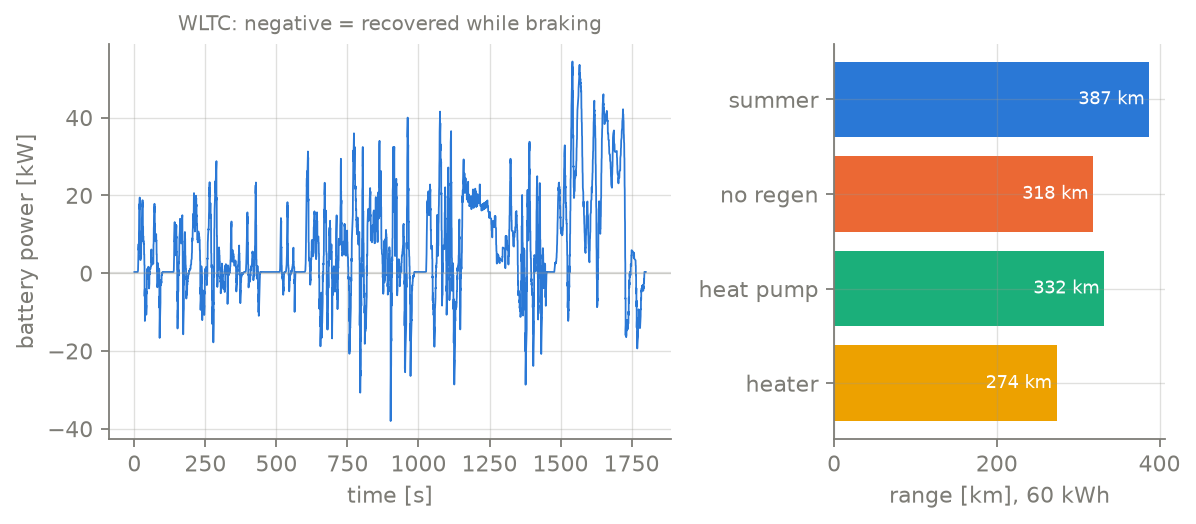
That is 15.5 kWh/100 km, and with 60 kWh usable a WLTP range of 387 km, typical for a mid-size electric car. The negative spikes in the battery power are the decelerations, where the motor charges the battery.
Winter
In winter the cabin must be heated, and an electric car has no waste heat from an engine. A resistive heater takes about 3 kW, the whole time: on the 30-minute cycle that is 1.5 kWh, more than a third of the driving energy.
| Situation | kWh/100 km | Range |
|---|---|---|
| summer | 15.5 | 387 km |
| no regenerative braking | 18.8 | 318 km |
| winter, heat pump (1.2 kW) | 18.1 | 332 km |
| winter, resistive heater (3 kW) | 21.9 | 274 km |
The heater costs more range than the whole regenerative braking gains; a heat pump gets most of it back. And the slower the driving, the larger the heater's share, because it takes power per hour, not per kilometre: in a traffic jam the heater can use more energy than the driving.
Experiments
| Try | What you will see |
|---|---|
regen_share = 0.5 |
half the braking with the friction brakes: 17.2 kWh/100 km |
m = 2200 (four passengers and luggage) |
17.4 kWh/100 km: the mass costs on every acceleration and on the rolling resistance |
cd_A = 0.55 instead of 0.66 (a sleeker car) |
14.5 kWh/100 km and 415 km: air drag dominates the WLTC's fast extra-high phase |
P_aux = 1000 |
a hot day with the air conditioning: 17.0 kWh/100 km, 353 km instead of 387 |
Next
Next in this topic: Tyre slip and traction control. Or pick another one from the tutorial overview.