Data types and fixed point
Most ECU software does not use double. Sensor values arrive as integers, memory is scarce, and many
microcontrollers have no floating-point unit, so signals are integers or fixed point. Nervus
simulates these types bit-true: the simulation gives exactly the values the generated C code computes.
Types
| Type | Meaning |
|---|---|
double, single |
64- and 32-bit floating point |
boolean |
0 or 1 |
int8, uint8, int16, uint16, int32, uint32 |
integers |
fixdt(s, w, f) |
fixed point: signed (s=1) or unsigned, w bits, f fraction bits (resolution 2⁻ᶠ) |
fixdt(s, w, slope, bias) |
fixed point with arbitrary scaling |
inherit |
take the type from the inputs |
A fixed-point signal stores an integer Q and represents the real value
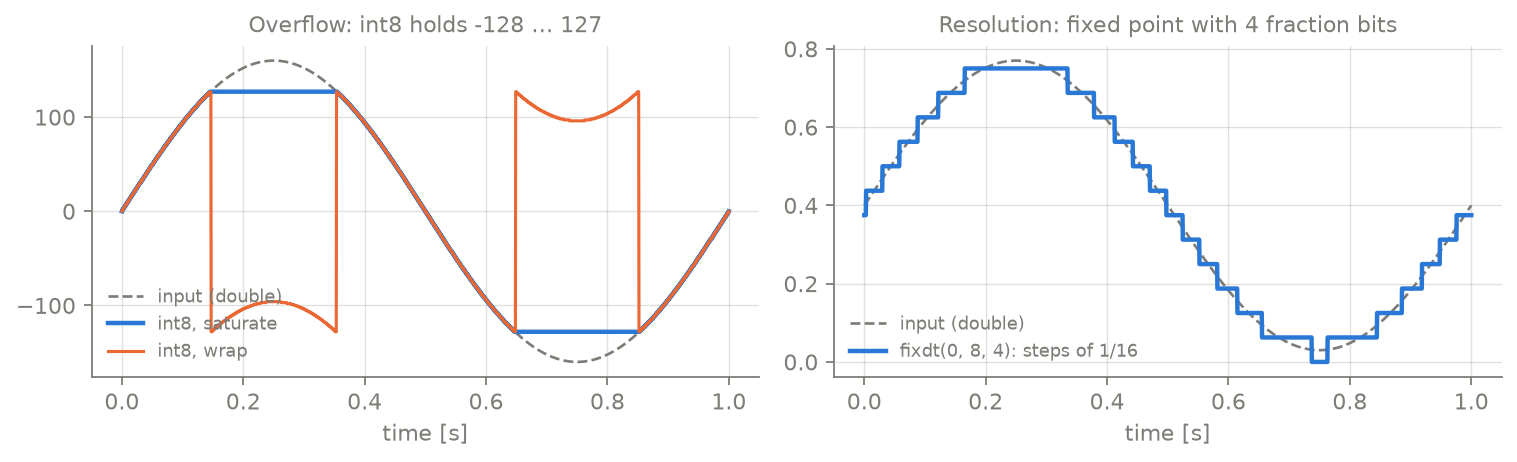
For example fixdt(1, 16, 8) covers −128 … 127.996 in steps of 1/256, and fixdt(0, 8, 0.5, -40) is a
temperature from −40 °C to 87.5 °C in 0.5 °C steps, in one byte. On wires the editor uses the short names
sfix16_En8 and ufix8_S0.5_B-40.
Setting types
- Data Type Conversion (Signal Attributes) converts a signal to a type, with a choice of rounding
(
nearest,floor,ceil,zero) and overflow (saturateorwrap):
- In, Constant, Gain, Sum, Product, Bias and the lookup tables have an output_type parameter.
- Everything else inherits. A block outputs the common type of its inputs (or
doubleif they differ). Logic and comparison blocks outputboolean. Continuous-time blocks, PID controllers and charts always usedouble.
Turn on View → Show Data Types to label every wire that carries a non-double type (Show Signal Widths and Sample Time Colours are next to it).
How it is simulated
Each block computes in double precision and its output is then converted to its type, with the block's
rounding and overflow mode (default: nearest and saturate). Doubles represent every 32-bit integer and
fixed-point value exactly, so this is bit-true.
Generated code
- The input and output structs use real C types (
int16_T,uint8_T,boolean_T, ...). Fixed-point ports carry the stored integer, and the header comment states the scaling. - Inside the step function, signals are converted with small generated helper functions
(
nv_q_int16_nearest_saturate, ...) that use exactly the same rounding and overflow as the simulation. The test suite checks this with a back-to-back test at zero tolerance. - The floating-point code computes in
doublebetween the conversions. For targets without an FPU, integer-only code keeps every signal a stored integer and computes with integers only, bit-true too.
Example
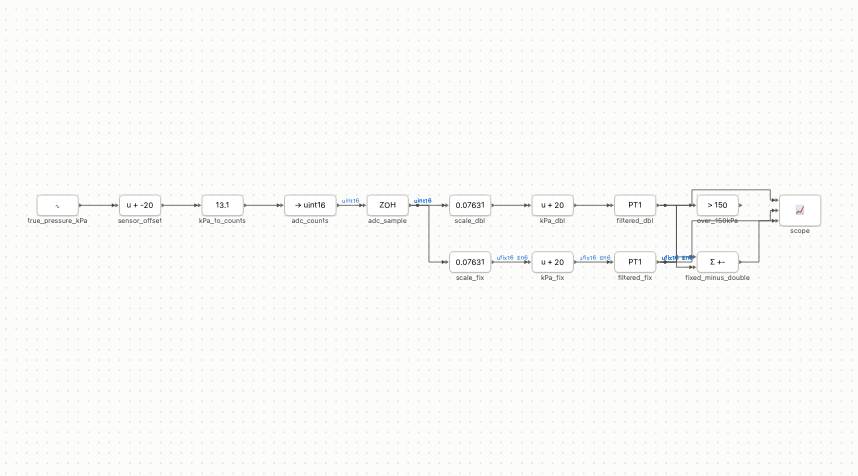
examples/fixed_point_sensor.py runs a pressure sensor chain twice: a 12-bit ADC (uint16 counts), scaling
to kPa, a PT1 filter and a limit check, once in double and once in fixdt(0, 16, 6). The largest
difference is 0.010 kPa, within the fixed-point resolution of 1/64 kPa. See the
fixed-point tutorial.