Lookup Tables
1-D Lookup Table
lookup.table_1d · Lookup Tables
1-D lookup table (a calibration curve): maps the input through a table of points.
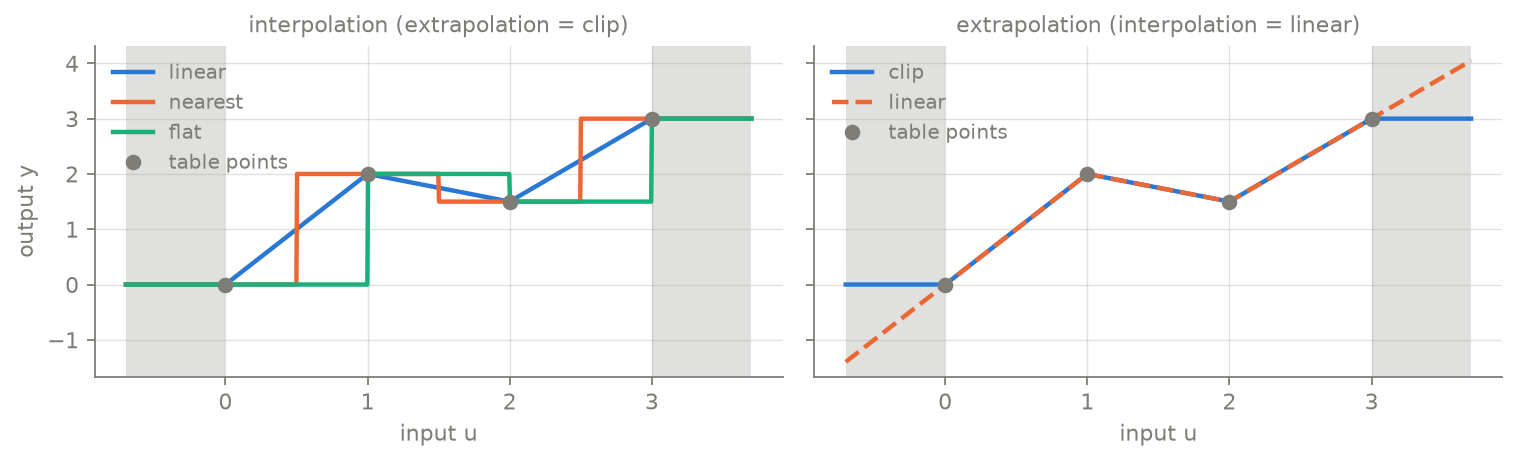
For an input between breakpoints \(x_i\) and \(x_{i+1}\) with linear interpolation:
- interpolation:
linear;nearest(closest point);flat(value of the breakpoint at or below the input, a staircase). - extrapolation:
clipholds the end values;linearextends the first/last segment.
Each element of a vector input is looked up separately.
Parameters
| Name | Default | Unit | Description |
|---|---|---|---|
breakpoints |
[0.0, 1.0, 2.0] |
Input values (strictly increasing) | |
table |
[0.0, 1.0, 4.0] |
Output value at each breakpoint | |
interpolation |
'linear' |
Between breakpoints — one of linear, nearest, flat |
|
extrapolation |
'clip' |
Outside the breakpoints — one of clip, linear |
|
output_type |
'double' |
Output data type: inherit, double, single, boolean, int8…uint32, fixdt(signed, bits, fraction) |
Direct feedthrough: yes
2-D Lookup Table
lookup.table_2d · Lookup Tables
2-D lookup table (a calibration map), e.g. ignition advance over engine speed and load.
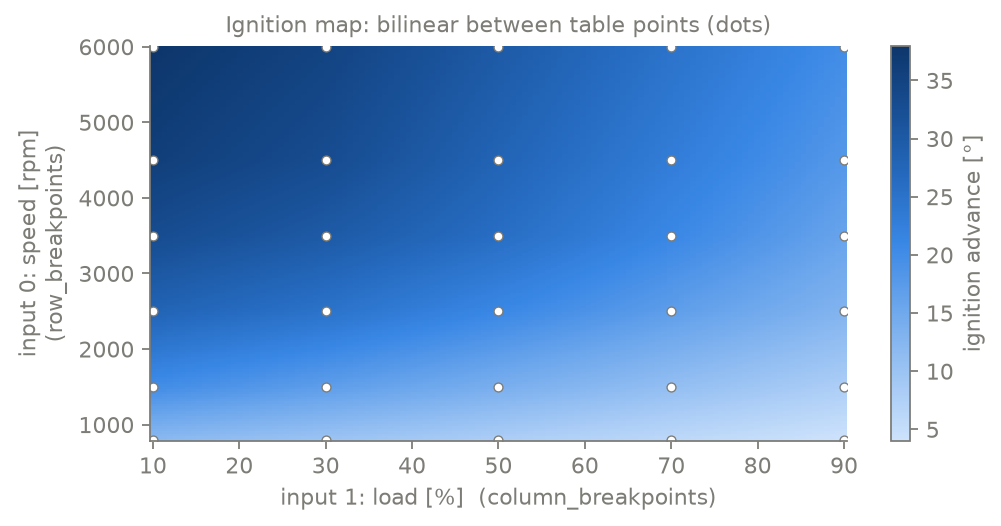
Input 0 selects the row (row_breakpoints) and input 1 the column (column_breakpoints).
table has one row per row breakpoint and one column per column breakpoint. With linear interpolation
the result is bilinear between the four surrounding points:
where \(f_r\) and \(f_c\) are the fractions within the row and column intervals. Interpolation and extrapolation work as in the 1-D table.
Parameters
| Name | Default | Unit | Description |
|---|---|---|---|
row_breakpoints |
[0.0, 1.0] |
Breakpoints for input 0 (rows) | |
column_breakpoints |
[0.0, 1.0] |
Breakpoints for input 1 (columns) | |
table |
[[0.0, 1.0], [1.0, 2.0]] |
Table: rows × columns | |
interpolation |
'linear' |
Between breakpoints — one of linear, nearest |
|
extrapolation |
'clip' |
Outside the breakpoints — one of clip, linear |
|
output_type |
'double' |
Output data type: inherit, double, single, boolean, int8…uint32, fixdt(signed, bits, fraction) |
Direct feedthrough: yes
Prelookup
lookup.prelookup · Lookup Tables
Breakpoint search on its own: finds the interval index k and the fraction f of the input.
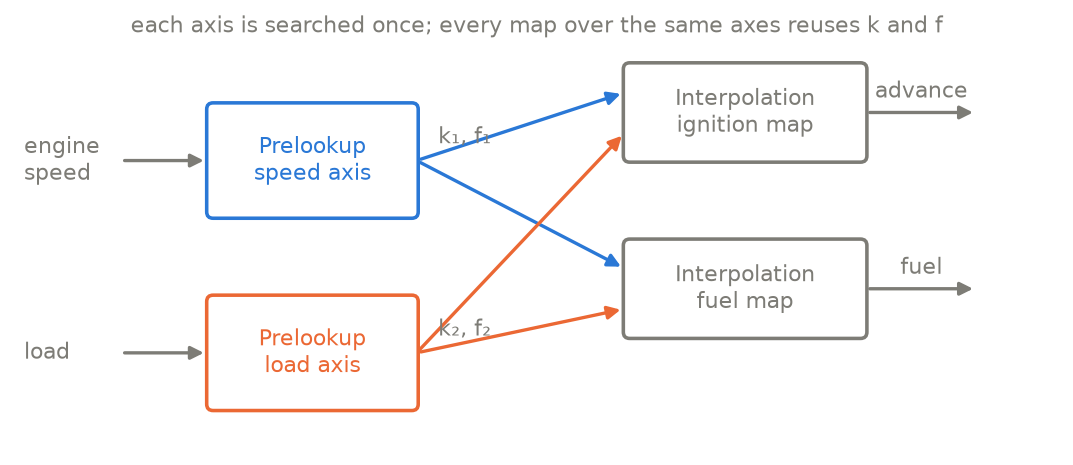
For an input between breakpoints \(x_k\) and \(x_{k+1}\):
Output 0 is k (0-based), output 1 is f. Feed both into one or more Interpolation blocks. ECUs calibrate many maps over the same axes (engine speed, load); searching the axis once and sharing the result saves time on the processor, and the A2L file can declare the axis as a shared axis.
With clip extrapolation, f stays in [0, 1]; with linear it continues outside.
Parameters
| Name | Default | Unit | Description |
|---|---|---|---|
breakpoints |
[0.0, 1.0, 2.0] |
Axis points (strictly increasing) | |
extrapolation |
'clip' |
Outside the breakpoints — one of clip, linear |
Direct feedthrough: yes
Interpolation using Prelookup
lookup.interpolation · Lookup Tables
Interpolates an n-D table (1 to 4 dimensions) at the index and fraction from Prelookup blocks.
Inputs: k1, f1 (1-D), k1, f1, k2, f2 (2-D, rows then columns), and so on: one Prelookup per
dimension. In 2-D the result is the same as a 2-D Lookup Table with linear interpolation over the same
breakpoints:
With more dimensions the same rule weights all \(2^n\) corners of the cell around the input. ECUs use 3-D
maps for example for a base value over speed × load, with a third axis such as coolant temperature or
the camshaft position. A 3-D table is a nested list: table[i][j][k].
Parameters
| Name | Default | Unit | Description |
|---|---|---|---|
dimensions |
1 |
Number of table dimensions (1 to 4) | |
table |
[0.0, 1.0, 4.0] |
Table values (1-D: one per breakpoint; 2-D: rows × columns) | |
output_type |
'double' |
Output data type: inherit, double, single, boolean, int8…uint32, fixdt(signed, bits, fraction) |
Direct feedthrough: yes
Adaptive Map
lookup.adaptive_map · Lookup Tables
A 2-D map that learns, like an ECU's long-term fuel trim or knock adaptation per load/speed cell.
Output: the table interpolated at (x, y), like a 2-D Lookup Table with clipped axes. Every sample while learn is ≥ 0.5 the table moves towards the correction input e at the cells around (x, y), each by its interpolation weight:
with the learning rate r (1/s) and the limit L. So each operating region gets its own correction: a lean error that only exists at idle is learned in the idle cells and does not disturb full load. The learned table is a state (it would be kept in the ECU's non-volatile memory).
Parameters
| Name | Default | Unit | Description |
|---|---|---|---|
row_breakpoints |
[0.0, 1.0] |
Breakpoints for x (rows) | |
column_breakpoints |
[0.0, 1.0] |
Breakpoints for y (columns) | |
initial |
0.0 |
Initial table (rows × columns, or one value for all cells) | |
rate |
0.1 |
1/s | Learning rate |
limit |
inf | Largest | |
sample_time |
0.01 |
s | Sample period |
Direct feedthrough: only some inputs (see above)