Tutorial: Lambda control and fuel trims
| You will learn | why petrol engines run at lambda = 1, closed-loop fuel control with a lambda sensor, short- and long-term fuel trims (as read over OBD-II), an ECU task in an atomic subsystem |
| Before this | Idle speed control |
| Level and time | intermediate, about 45 minutes |
| Follow along | start the editor (uv run nervus), File ▸ Open examples/lambda_control.nervus, press ▶ and double-click the scopes; the figures below come from the same model |
| Topic | Powertrain and engine control ▸ Engine management (all tutorials) |
This tutorial follows examples/lambda_control.py. It shows how a petrol engine's ECU keeps the air-fuel
ratio at the value the catalytic converter needs, and what the fuel trims that you can read from your car
over OBD-II actually are.
uv run python examples/lambda_control.py      # simulates, saves lambda_control.nervus, runs the tests
uv run nervus examples/lambda_control.nervus  # open it in the editor
Why lambda = 1
Burning petrol completely takes 14.7 kg of air per kg of fuel, the stoichiometric air-fuel ratio. The air-fuel equivalence ratio lambda compares the actual mixture with it:
λ > 1 is lean (too much air), λ < 1 is rich. A three-way catalyst removes CO, HC and NOx at the same time only in a narrow window around λ = 1, so the ECU controls λ to 1 at part load all the time.
The model
Plant (the engine), top and bottom rows:
- the air charge per cylinder stroke: 250 mg at part load, a tip-in to 400 mg from 4 s to 8 s;
- from t = 12 s a vacuum leak: 6 % extra air that enters behind the MAF sensor, so the ECU doesn't see it;
- the injectors: fuel mass = (injection time − dead time) × flow rate;
- the exhaust gas needs \(n_{exh}\) = 8 samples × 10 ms to reach the lambda sensor, and the sensor itself has a time constant \(\tau\) = 0.1 s.
ECU: the ECU block is an atomic subsystem with
sample_time = Ts (10 ms), the fuel task:
- The base fuel comes from the measured air (feed-forward). If the sensors and injectors were perfect, this alone would give λ = 1.
- The short-term fuel trim (STFT) is a discrete PI controller on the lambda error \(e = \lambda_{meas} - 1\), limited to ±25 %. Lean (e > 0) means more fuel.
- The long-term fuel trim (LTFT) integrates the STFT slowly: \(LTFT[k+1] = LTFT[k] + K_{ltft}\,T_s\,STFT[k]\). It moves the average correction out of the STFT, which then returns to 0 and has its full ±25 % available again for fast disturbances.
What happens
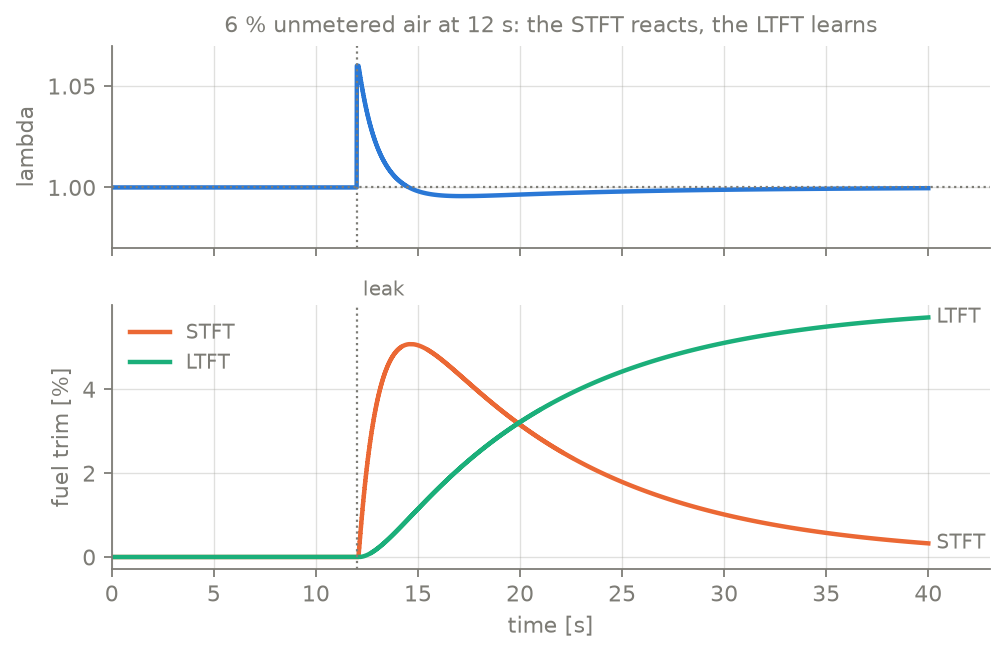
- Up to 12 s λ stays at 1, even during the tip-in: the base fuel follows the measured air.
- At 12 s the leak makes the mixture 6 % lean. The lambda sensor sees it about 0.2 s later (exhaust delay and sensor lag); the STFT rises to about +5 % within three seconds and brings λ back to 1.
- Over the next 25 s the LTFT learns the leak: it rises to almost +6 % while the STFT falls back to 0.
A real ECU stores the LTFT, often per load and speed range, and keeps it when the engine is switched off. It also sets a trouble code when a trim reaches its limit, such as P0171 System too lean (see the OBD-II page).
Compare with your car
Your car reports the same two numbers as OBD PIDs 06 (stft_b1) and 07 (ltft_b1):
uv run python -m nervus.obd record --port /dev/tty.usbserial-1110 \
    --pids rpm,maf,stft_b1,ltft_b1,o2_b1s1 --duration 300 --out my_drive.nervres
- A healthy engine has an LTFT within about ±5 % and an STFT that keeps moving around 0.
- An LTFT of +10 % or more at idle that gets smaller at higher load is the classic sign of a vacuum leak: the leak is a fixed amount of air, so it matters most when little air is flowing.
- An LTFT that is high at all loads points more to fuel delivery (pump pressure, injectors) or the MAF sensor.
Experiments
To try one: change the value in the Model Workspace tab (double-click it), or for a block parameter select the block and edit it in Properties; press ▶ and compare with the previous run in the Data Inspector (Ctrl+I). Ctrl+Z undoes the change.
Change the workspace variables in the Model Workspace panel and run again:
| Try | What you will see |
|---|---|
injector_error = -0.05, leak = 0 |
clogged injectors: the LTFT learns about +5.3 % (= 1/0.95 − 1) |
K_ltft = 0.5 |
faster learning, but the trims overshoot: the STFT goes negative and λ dips rich (0.987) |
Ki_stft = 4 |
a faster STFT (peak after 0.7 s instead of 2.7 s), with some overshoot |
n_exh = 20 and Ki_stft = 4 |
a longer exhaust delay with a fast STFT: much more overshoot, λ dips to 0.98. The delay limits how fast the STFT can be |
The test cases in the Test Manager check the leak and clogged-injector cases, and that λ stays at 1
during the tip-in. Generate C code for the ECU block (Code → Generate C) to get the fuel task as ECU code.
Next
Next in this topic: Ignition timing and knock control. Or pick another one from the tutorial overview.