Tutorial: The injector driver power stage
| You will learn | a low-side switch driving a solenoid injector, opening delay versus battery voltage, freewheeling diode versus clamp, why injection needs a battery voltage correction |
| Before this | RC and RLC circuits |
| Level and time | intermediate, about 30 minutes |
| Follow along | start the editor (uv run nervus), File ▸ Open examples/injector_driver.nervus, press ▶ and double-click the scopes; the figures below come from the same model |
| Topic | Electrics and electronics ▸ ECU hardware and PCB (all tutorials) |
A fuel injector is a solenoid valve, switched by a transistor on the ECU's circuit board. How long it is really open,
and so how much fuel the engine gets, depends on that circuit and on the battery voltage, not only on the pulse the
software commands. examples/injector_driver.py models the power stage and shows the two effects every injection
software compensates.
uv run python examples/injector_driver.py
The circuit
| Part | Value |
|---|---|
| battery | 9-15 V (V_bat), the injector's supply |
| injector | Fuel Injector block: 12 Ω, 10 mH, the needle lifts above 0.6 A and drops below 0.3 A, 3.5 g/s when open |
| low-side switch | the ECU's transistor between the injector and ground, 0.1 Ω when on |
| clamp | the transistor's avalanche clamp: limits its voltage to 60 V |
| freewheeling diode | optional (freewheel = 1): across the coil, from the transistor back to the battery |
The software commands a 3 ms pulse. At 3.5 g/s that should be 10.5 mg of fuel.
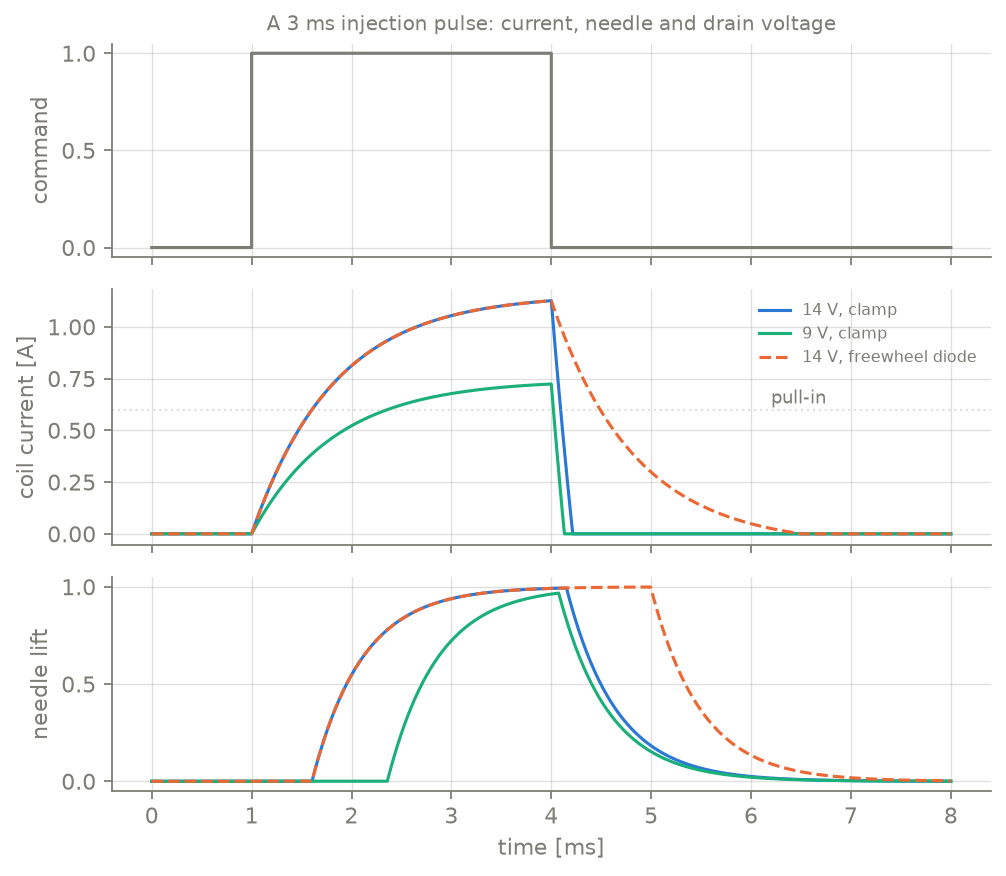
Opening: the battery voltage matters
When the transistor switches on, the coil current rises with the time constant \(\tau = L/R = 0.83\) ms towards \(V_{bat}/R\):
The needle only starts to lift when the current passes the pull-in current (0.6 A), and then needs 0.5 ms to travel. At 14 V the injector is open (half lift) 0.96 ms after the command; at 9 V, where the current only just reaches 0.6 A (9/12.1 = 0.74 A at the end), it takes 1.71 ms.
Closing: freewheeling diode or clamp
When the transistor switches off, the coil keeps driving its current:
- With a freewheeling diode, the current circulates through the diode and decays slowly with τ; the voltage at the transistor stays near the battery voltage (14.7 V at 14 V). The needle closes 1.34 ms after the end of the pulse.
- Without it, the current has nowhere to go; the transistor's voltage jumps until the clamp conducts at 60 V, and the high voltage drives the current down fast. The needle closes 0.50 ms after the end. That is why injector drivers use a clamp: a fast, repeatable closing. The price is a transistor rated for 60 V and the energy dissipated in it at every injection.
What the engine gets
| Battery | Driver | Opens after | Closes after | Fuel (3 ms command) |
|---|---|---|---|---|
| 9 V | clamp | 1.71 ms | 0.41 ms | 6.0 mg |
| 12 V | clamp | 1.12 ms | 0.46 ms | 8.2 mg |
| 14 V | clamp | 0.96 ms | 0.50 ms | 8.9 mg |
| 15 V | clamp | 0.90 ms | 0.51 ms | 9.2 mg |
| 14 V | freewheel diode | 0.96 ms | 1.34 ms | 11.9 mg |
The same command delivers 50 % more fuel at 15 V than at 9 V. An engine ECU therefore adds a battery voltage correction (the injector's "dead time", a table over the battery voltage) to every pulse, so a cold start on a weak battery still gets the fuel it needs. The table comes from exactly this kind of measurement, on the bench with the real injector and driver.
Experiments
| Try | What you will see |
|---|---|
freewheel = 1 |
a slow, voltage-independent closing: more fuel, and a different dead-time table |
V_bat = 9 with freewheel = 0 |
the current barely reaches the pull-in level: a weak battery at a cold start |
the injector's L = 0.005 |
a faster coil: it opens earlier, and the voltage dependence shrinks |
the injector's I_pull = 0.75 |
at 9 V the current never reaches pull-in: the injector does not open at all |
Next
That was the last tutorial on electrics and electronics. Continue with ecu software, communication and diagnostics: A vehicle network (CAN), or pick another one from the tutorial overview.