Diagnostics
Diagnostic Monitor
diagnostics.monitor · Diagnostics
A diagnostic monitor with a trouble code (DTC), like the diagnostic event manager of an engine ECU.
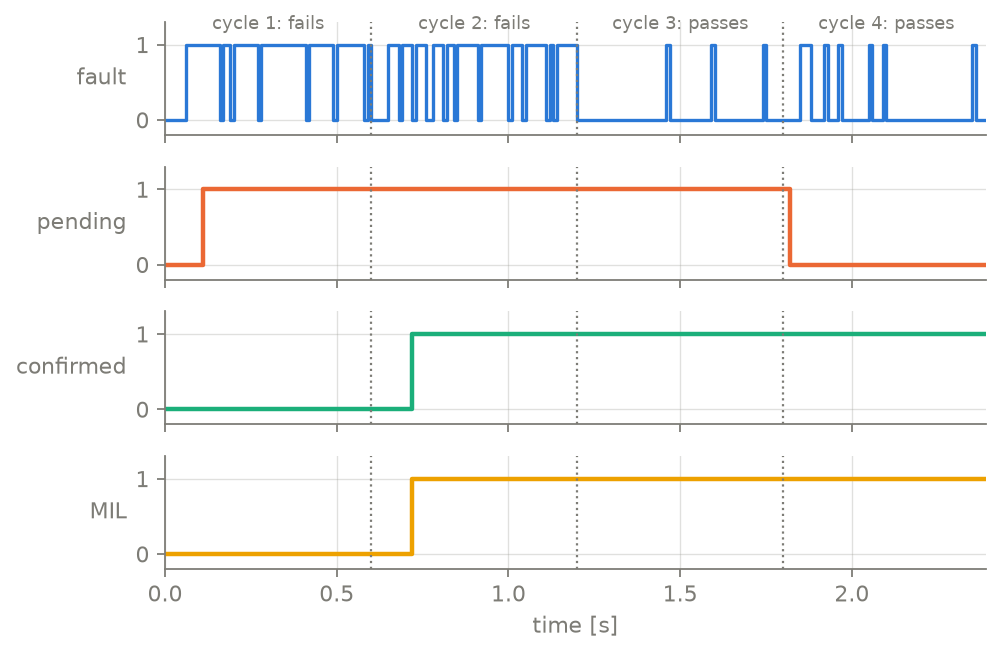
Input fault is the raw test result of a monitor (≥ 0.5 = the test failed this sample), e.g.
rpm_variation > limit for a misfire monitor. It is debounced with a counter, so a short glitch does
not set a code:
The test has failed when the counter reaches T (threshold) and passed when it reaches −T. Like OBD-II, the code is then handled over operation cycles (drive cycles):
- the first failure makes the code pending at once;
- after confirm_cycles operation cycles in a row with a failure (2: "two-trip" detection) it is confirmed, and the MIL (check-engine lamp) comes on if mil is set;
- after heal_cycles cycles in a row that passed without failure, the MIL goes off again (the code stays stored as confirmed, so a workshop can still read it); a cycle without failure also clears pending.
Optional inputs (parameters): enable (the test conditions are met, e.g. engine warm; the counter holds while it is 0), cycle (a rising edge starts a new operation cycle, e.g. key on), and clear (a rising edge clears the code like OBD mode 04: also the readiness).
Outputs: mil, pending, confirmed, ready (the monitor has completed, passed or failed, since the code was last cleared: the OBD readiness of this monitor) and status: the UDS status byte (bit 0 test failed, 1 failed this cycle, 2 pending, 3 confirmed, 4 not completed since clear, 5 failed since clear, 6 not completed this cycle, 7 warning indicator). Outputs change one sample after the input that causes them. Runs at its sample time.
Parameters
| Name | Default | Unit | Description |
|---|---|---|---|
dtc |
'P0300' |
Trouble code, e.g. P0171 (system too lean) | |
threshold |
10.0 |
Debounce threshold T: failed at +T, passed at -T | |
fail_step |
1.0 |
Counter step up for each failed sample | |
pass_step |
1.0 |
Counter step down for each passed sample | |
jump_down |
True |
A failure after passing restarts counting from 0 | |
confirm_cycles |
2 |
Operation cycles in a row with a failure to confirm | |
heal_cycles |
3 |
Passed cycles in a row before the MIL goes off | |
mil |
True |
A confirmed code switches the MIL on | |
enable_input |
False |
Add an input: the test conditions are met | |
cycle_input |
False |
Add an input: a rising edge starts a new operation cycle | |
clear_input |
False |
Add an input: a rising edge clears the code (mode 04) | |
sample_time |
0.01 |
s | Sample period |
Direct feedthrough: no
OBD Responder
diagnostics.obd_responder · Diagnostics
Makes the model answer OBD-II requests like a car's engine ECU, while the simulation runs.
Its inputs are the values of the PIDs in pids (e.g. rpm, speed, coolant_temp; see
python -m nervus.obd pids), then the status bytes of the trouble codes in dtcs (wire the status
output of a Diagnostic Monitor to each). Every sample they are published to the simulated ECU named
ecu, which answers requests from a diagnostic tool:
- mode 01: the PIDs, and PID 01 with the MIL and the number of confirmed codes;
- modes 03 / 07 / 0A: confirmed, pending and permanent codes;
- mode 04 (clear codes): the output clear is 1 for one sample; wire it to the clear input of the Diagnostic Monitors so the model really clears them;
- mode 09: the VIN.
Run the model with python -m nervus.obd simulate model.nervus: it runs in real time and offers the ECU
as an ELM327 adapter on a serial port (a pseudo-terminal) for any OBD program, or on a CAN bus. This block is
part of the test setup: it has no C code.
Parameters
| Name | Default | Unit | Description |
|---|---|---|---|
ecu |
'ecu' |
Name of the simulated ECU | |
pids |
'rpm, speed, coolant_temp' |
PIDs to report, one input each | |
dtcs |
'' |
Trouble codes, one status input each (from Diagnostic Monitors) | |
sample_time |
0.1 |
s | How often the ECU's values are updated |
Direct feedthrough: no