Tutorial: Anti-lock braking (ABS)
| You will learn | braking slip and the tyre's friction peak, a quarter-car model, hydraulic pressure modulation, a threshold ABS as a State Chart, stopping distances on dry, wet and icy roads |
| Before this | Tyre slip and traction control |
| Level and time | intermediate, about 35 minutes |
| Follow along | start the editor (uv run nervus), File ▸ Open examples/abs_braking.nervus, press ▶ and double-click the scopes; the figures below come from the same model |
| Topic | Vehicle dynamics and energy ▸ Chassis control (all tutorials) |
examples/abs_braking.py brakes a car as hard as possible from 100 km/h, with and without ABS. Without it the
wheels lock: the car slides further and cannot be steered. With it, an ECU modulates the brake pressure dozens of
times a second to keep the tyres at the slip where they grip best.
uv run python examples/abs_braking.py
The model
A quarter car: one wheel carrying a quarter of a 1600 kg car (400 kg), with a 0.31 m tyre and a wheel inertia of 1.2 kg·m². The tyre force depends on the slip between the car and the wheel,
through Pacejka's magic formula, as in the traction control tutorial: on this tyre the friction peaks at 15 % slip and a locked wheel keeps only 71 % of the peak. The car decelerates by the tyre force; the wheel by the brake torque minus the tyre's torque.
The brake is a torque that the hydraulic unit changes at a limited rate (8000 N·m/s up, 16000 N·m/s down). The driver asks for 2500 N·m from 0.5 s: much more than the tyre can transmit (about 1200 N·m), so the wheel would lock.
The ABS ECU is a State Chart running every 5 ms, the classic threshold algorithm:
| State | Valves | Leave when |
|---|---|---|
| build | inlet open: the pressure rises towards the driver's demand | slip > 10 % → hold, > 20 % → release |
| hold | both closed: the pressure stays | slip > 20 % → release, < 10 % → build |
| release | outlet open: the pressure falls | slip < 10 % → build |
Below 7 km/h the ABS stops controlling, as in real cars.
Results
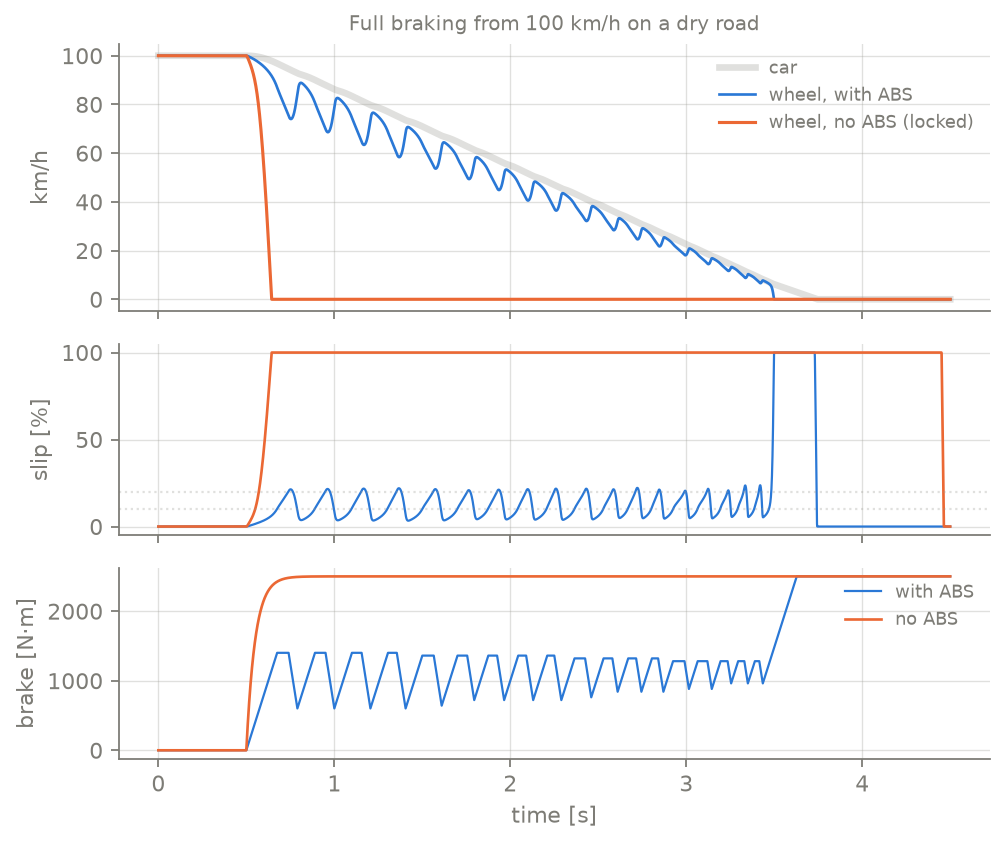
Without ABS the wheel locks 0.14 s after the driver brakes: it stops turning while the car slides on. With ABS the wheel speed dips and recovers six times a second, the slip oscillates between 3 and 23 %, and the brake torque saws up and down; that is the pulsing you feel in the pedal.
| Road | mu_road |
Stopping distance with ABS | without ABS |
|---|---|---|---|
| dry | 1.0 | 45.7 m | 54.9 m |
| wet | 0.5 | 97.0 m | 110.2 m |
| ice | 0.15 | 276 m | 367 m |
The physical limit on the dry road is \(v^2 / (2 \mu g) = 39\) m: the ABS reaches 86 % of the tyre's best grip. The shorter distance is a bonus; the main purpose of ABS is that a rolling wheel can still produce side force, so the driver can steer around the obstacle.
Experiments
| Try | What you will see |
|---|---|
abs_on = 0 |
the wheel locks (slip 100 %) and the car slides 9 m further on a dry road |
slip_hold = 0.05, slip_release = 0.10 |
too careful: the tyre never reaches its peak, 49.3 m |
slip_hold = 0.2, slip_release = 0.4 |
too late: the slip reaches 61 %, past the peak, 54.2 m |
release_rate = 4000 |
slower release: 43.4 m, but the slip peaks at 29 %; a trade-off between distance and steerability |
T_driver = 1500 |
a gentler driver still locks the wheel without ABS: 1200 N·m is all the tyre can take |
Next
That was the last tutorial on vehicle dynamics and energy. Continue with electrics and electronics: RC and RLC circuits, or pick another one from the tutorial overview.