Tutorial: Radiator fan control
| You will learn | on/off control with hysteresis, a thermal model with a lookup table, sensor filtering and its delay, switching rate versus temperature swing |
| Before this | Your first model: a cruise control |
| Level and time | beginner, about 25 minutes |
| Follow along | start the editor (uv run nervus), File ▸ Open examples/coolant_fan.nervus, press ▶ and double-click the scopes; the figures below come from the same model |
| Topic | Powertrain and engine control ▸ Engine management (all tutorials) |
examples/coolant_fan.py is one of the simplest and most common ECU functions: switch the electric radiator fan
on when the coolant gets hot. It shows why on/off control needs hysteresis, and what a sensor filter does to a
control loop.
uv run python examples/coolant_fan.py
The model
The cooling circuit is one thermal capacity \(C_{th} = 40\) kJ/K (coolant, engine block, radiator):
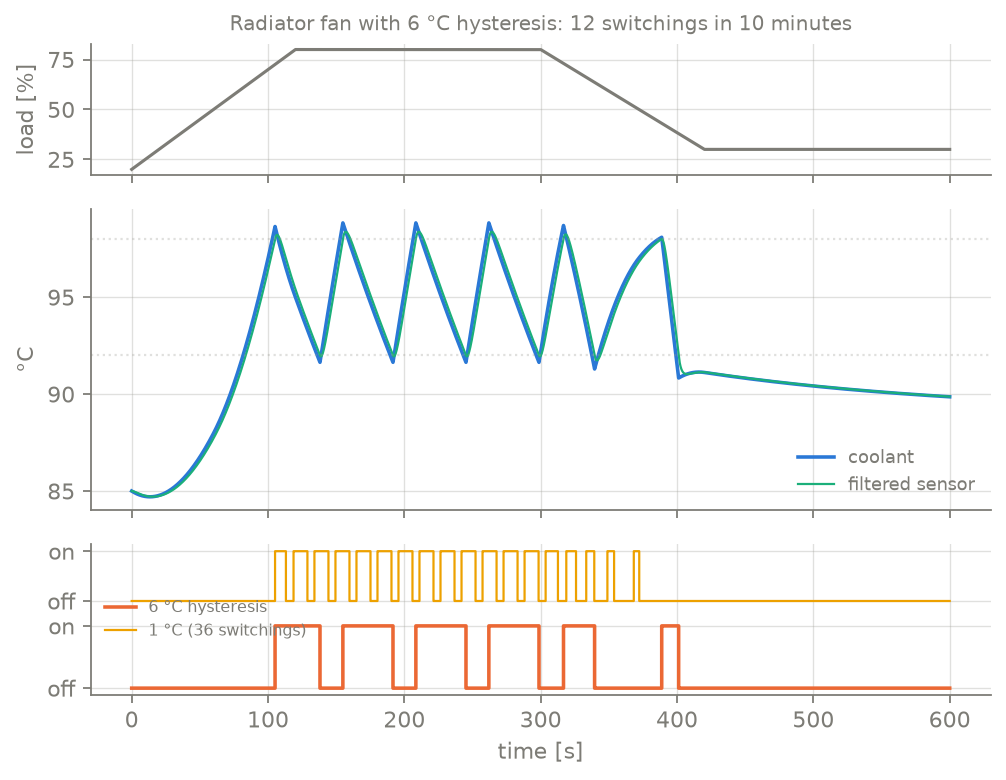
The engine heat comes from a 1-D lookup table over the engine load (5 kW at idle, 40 kW at full load); natural cooling grows with the temperature above ambient; the fan removes 25 kW when it runs. The load ramps up to 80 %, stays there, and drops back to 30 %.
The ECU reads the temperature sensor every 10 ms, smooths it with a first-order filter (2 s), and switches the fan with a Relay block: on above 98 °C, off below 92 °C.
Why hysteresis
With one switching point the fan would chatter: it switches on at 98 °C, the temperature drops a few tenths, and it switches off again, many times a second at the edge. The relay's two thresholds give a dead band: once on, the fan runs until the coolant is 6 °C cooler. Over the 10 minutes the fan switches 12 times, runs 30 % of the time, and the coolant peaks at 98.8 °C. Each switching costs relay and motor life and makes a noise the driver hears, so the band is a trade-off between temperature swing and switching rate.
The sensor filter removes noise but adds delay: the ECU sees the temperature about 2 s late, which is why the coolant goes a little above 98 °C before the fan starts.
Experiments
| Try | What you will see |
|---|---|
T_off = 97 (1 °C hysteresis) |
36 switchings instead of 12; the fan cycles every 14 s |
T_on = 95, T_off = 93 |
a cooler engine (95.8 °C peak), but 26 switchings |
tau_sensor = 10 |
the ECU reacts late: the coolant overshoots to 101.7 °C and the test case fails |
P_fan = 15 (a weaker fan) |
at 80 % load the fan cannot keep up: 103 °C, and the test case fails |
Run the test case in the Test Manager after each change: it checks that the coolant stays below 100 °C.
Next
Next in this topic: Idle speed control. Or pick another one from the tutorial overview.