Tutorial: Ignition timing and knock control
| You will learn | spark advance from a speed/load map (2-D lookup table), knock and the knock limit, a knock controller that retards and recovers, noisy sensors |
| Before this | Idle speed control, Lambda control and fuel trims |
| Level and time | intermediate, about 30 minutes |
| Follow along | start the editor (uv run nervus), File ▸ Open examples/ignition_knock.nervus, press ▶ and double-click the scopes; the figures below come from the same model |
| Topic | Powertrain and engine control ▸ Engine management (all tutorials) |
This tutorial follows examples/ignition_knock.py. It is the third part of the engine-control series, after
idle speed control and lambda control.
uv run python examples/ignition_knock.py
Spark advance
The flame needs time to burn through the charge, so the spark fires before top dead centre: the advance, in degrees of crank angle. The best torque comes at MBT (minimum advance for best torque); with less advance the pressure peaks too late. The torque efficiency in this model falls off quadratically:
The ECU reads the base advance from a map over speed and load (advance_map, calibration data): more
advance at high speed (less time per degree), less at high load.
Knock
At high load, the last part of the charge can ignite by itself before the flame reaches it: knock, a sharp pressure wave that damages pistons and head gaskets. It starts at the knock limit, which is lower with low-octane fuel, hot intake air, a hot engine and high load. At full load the knock limit is below MBT, so the engine is knock limited: the calibration keeps 2-3° below the knock limit of the reference fuel.
A knock sensor (an accelerometer on the engine block) picks up the vibration. In the model, the knock intensity grows with the square of the advance beyond the limit, with cycle-to-cycle scatter (a Sensor Model with noise).
Knock control
The ECU (10 ms task) counts a knock event when the sensor exceeds a threshold, and for each event retards the spark by 3°; the retard then recovers by 1°/s:
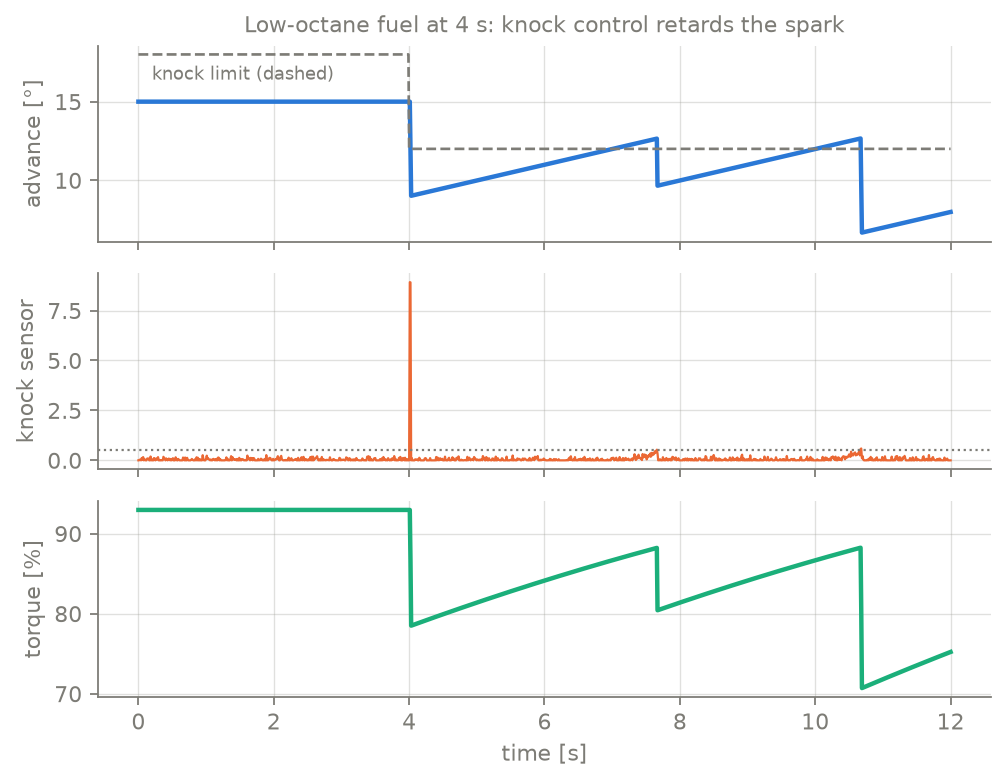
At 4 s the car gets low-octane fuel, and the knock limit drops by 6° to 12°. The first combustions knock hard; the ECU retards, and from then on the advance makes a sawtooth just around the new limit. It creeps up at 1°/s until a knock occurs, then steps back 3°. On average the spark is retarded by 5°, and the engine gives up 12 % torque (from 93 % to 81 %): the price of the cheaper fuel. Real ECUs do this per cylinder, and learn the retard into a map so the engine starts at the right timing.
The ECU subsystem generates C code; the test compares it back to back with the simulation.
Experiments
To try one: change the value in the Model Workspace tab (double-click it), or for a block parameter select the block and edit it in Properties; press ▶ and compare with the previous run in the Data Inspector (Ctrl+I). Ctrl+Z undoes the change.
| Try | What you will see |
|---|---|
knock_recover = 3 |
the advance creeps up faster: twice as many knock events, but less time far below the limit (82 % torque) |
knock_step = 1 |
smaller steps: the advance stays closer to the limit (3° average retard, 86 % torque) |
knock_threshold = 0.2 |
noise starts to count as knock: the ECU retards almost 12° and the torque falls to 57 % |
Next
Next in this topic: Wall wetting and learned fuel trims. Or pick another one from the tutorial overview.