Tutorial: Wall wetting and learned fuel trims
| You will learn | fuel film dynamics (x-tau) and transient compensation, a switching lambda sensor, long-term trims learned per load cell (Adaptive Map) |
| Before this | Lambda control and fuel trims |
| Level and time | intermediate, about 30 minutes |
| Follow along | start the editor (uv run nervus), File ▸ Open examples/fuel_film.nervus, press ▶ and double-click the scopes; the figures below come from the same model |
| Topic | Powertrain and engine control ▸ Engine management (all tutorials) |
This tutorial follows examples/fuel_film.py and continues lambda control with three
things every production fuel system has.
uv run python examples/fuel_film.py
Wall wetting (x-tau)
Part of the fuel injected into the intake port lands on its wall and evaporates later. With the share X that deposits and the evaporation time constant τ:
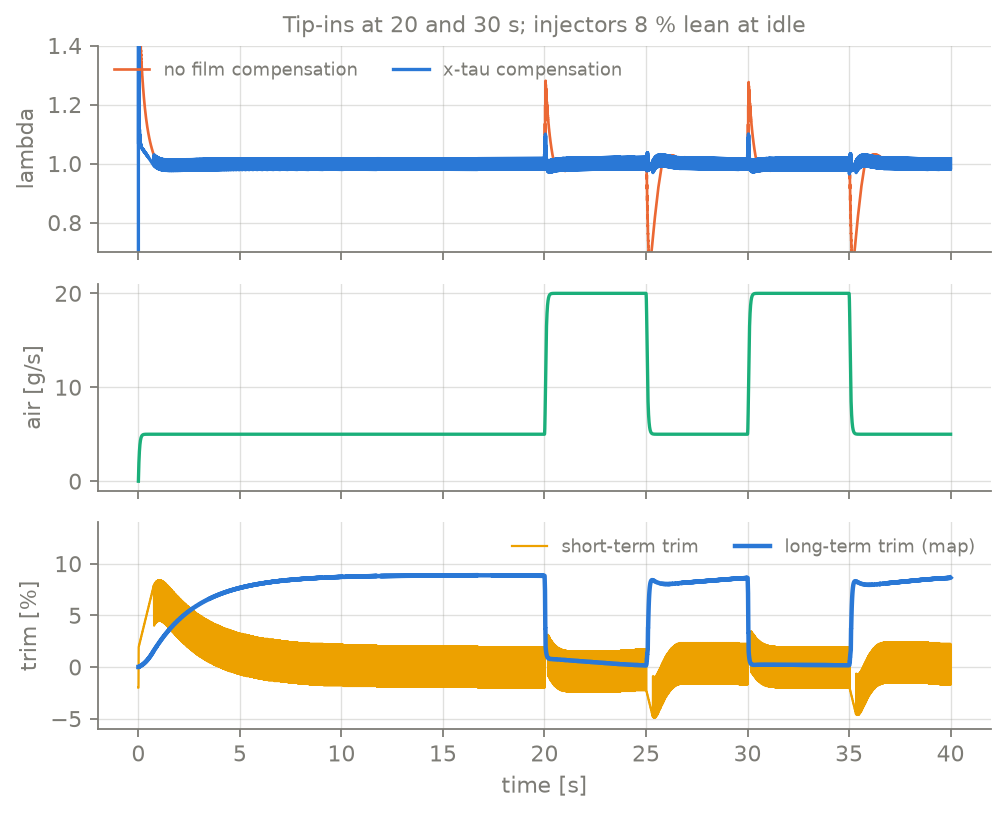
On a tip-in (air flow 5 → 20 g/s) the film first has to grow, so the cylinders get too little fuel and the engine runs lean, then rich on the tip-out. Without compensation lambda jumps by 28 %. The ECU runs the same model with its own film estimate and injects
which cuts the excursion to 10 % here (the rest comes from the manifold filling and the 10 ms task).
A switching lambda sensor
A narrow-band (zirconia) sensor only says rich (about 0.8 V) or lean (about 0.1 V). The short-term trim therefore jumps by 2 % when the sensor switches and ramps by 8 %/s in between: lambda oscillates in a small limit cycle around 1, which is also what the catalyst needs to store and release oxygen.
Long-term trims per load cell
The injectors in this model deliver 8 % too little at low flow (an injector non-linearity at short pulses). The long-term trim is an Adaptive Map over the air flow: it learns the average short-term trim in the cells around the current operating point. At idle it learns +8.8 %; at 20 g/s it stays near 0 %, and when the engine comes back to idle, the idle correction is still there, so the short-term trim does not have to start over. A single long-term trim would be pulled back and forth between the two regions.
Experiments
To try one: change the value in the Model Workspace tab (double-click it), or for a block parameter select the block and edit it in Properties; press ▶ and compare with the previous run in the Data Inspector (Ctrl+I). Ctrl+Z undoes the change.
| Try | What you will see |
|---|---|
xtau_comp = 0 |
28 % lean and rich spikes on every tip-in and tip-out |
X_film = 0.5 and xtau_comp = 0 (a cold engine, no compensation) |
46 % spikes; a real ECU makes X and τ depend on the coolant temperature |
ltft_rate = 0.1 |
the map learns slowly: after 20 s it has 6.7 % and the short-term trim still carries the rest |
Next
Next in this topic: Gear-shift logic. Or pick another one from the tutorial overview.