Discontinuities
Dead Zone
discontinuities.dead_zone · Discontinuities
Zero output inside the dead zone [start, end]; outside, the input shifted by the zone edge.
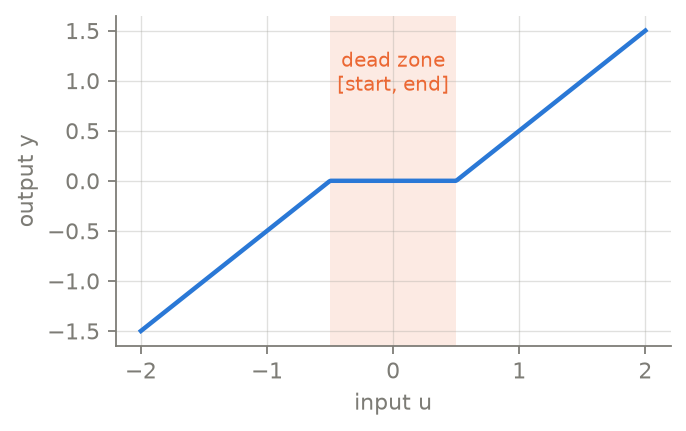
Typical use: ignore small pedal or sensor noise around zero.
Parameters
| Name | Default | Unit | Description |
|---|---|---|---|
start |
-0.5 |
Lower edge of the dead zone | |
end |
0.5 |
Upper edge of the dead zone |
Direct feedthrough: yes
Quantizer
discontinuities.quantizer · Discontinuities
Rounds the input to a multiple of interval, like an ADC or a fixed-resolution sensor.
Parameters
| Name | Default | Unit | Description |
|---|---|---|---|
interval |
0.5 |
Quantization interval q |
Direct feedthrough: yes
Relay
discontinuities.relay · Discontinuities
Switch with hysteresis: turns on when the input rises to on_point and off when it falls to off_point. In between it keeps its previous state.
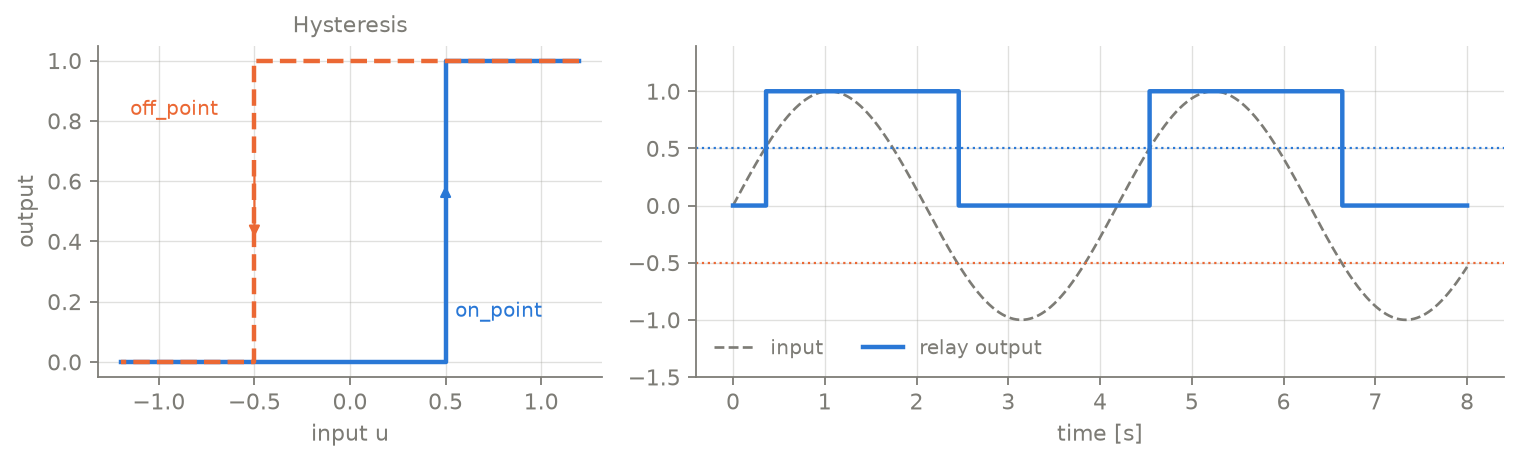
The output is on_value when \(s = 1\) and off_value when \(s = 0\). Use it for thermostats, fan control or any on/off decision that must not chatter. The relay is evaluated at its sample time, so it needs a discrete rate (set sample_time, or drive it from a discrete block).
Parameters
| Name | Default | Unit | Description |
|---|---|---|---|
on_point |
1.0 |
Switch on when u >= on_point | |
off_point |
0.0 |
Switch off when u <= off_point | |
on_value |
1.0 |
Output when on | |
off_value |
0.0 |
Output when off | |
initial_state |
'off' |
State before the first sample — one of off, on |
|
sample_time |
-1 (inherited) | s | Sample period (-1 = inherit) |
Direct feedthrough: yes
Rate Limiter
discontinuities.rate_limiter · Discontinuities
Limits how fast the signal may change, e.g. torque or throttle ramps for drivability.
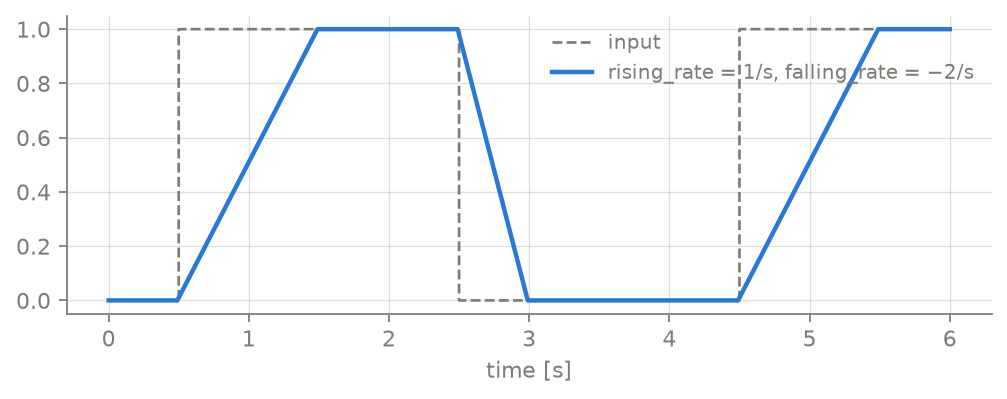
with rising rate \(R_r > 0\) and falling rate \(R_f < 0\) in units per second, and sample period \(T\).
Parameters
| Name | Default | Unit | Description |
|---|---|---|---|
rising_rate |
1.0 |
1/s | Maximum increase per second |
falling_rate |
-1.0 |
1/s | Maximum decrease per second (negative) |
initial |
0.0 |
Output before the first sample | |
sample_time |
-1 (inherited) | s | Sample period (-1 = inherit) |
Direct feedthrough: yes
Saturation
math.saturation · Discontinuities
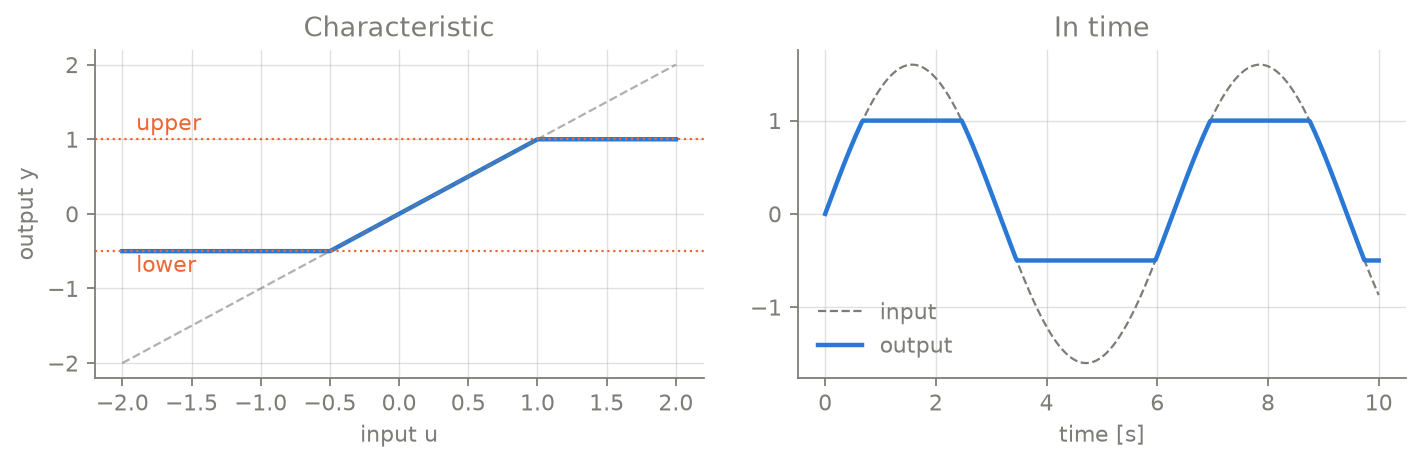
Limits the input to the range [lower, upper]:
Parameters
| Name | Default | Unit | Description |
|---|---|---|---|
upper |
0.5 |
Upper limit | |
lower |
-0.5 |
Lower limit |
Direct feedthrough: yes