Tutorial: A sensor signal chain in fixed point
| You will learn | fixed-point data types (word length, fraction bits, resolution, range), an ADC model, quantization error, and the silent failure of a badly chosen range |
| Before this | From model to ECU C code; read Data types and fixed point first |
| Level and time | intermediate, about 30 minutes |
| Follow along | start the editor (uv run nervus), File ▸ Open examples/fixed_point_sensor.nervus, press ▶ and double-click the scopes; the figures below come from the same model |
| Topic | ECU software, communication and diagnostics ▸ From model to ECU code (all tutorials) |
Many ECU microcontrollers have no floating-point unit, or the code must be fast and deterministic, so signals are
stored as integers with a scale. examples/fixed_point_sensor.py runs a manifold pressure sensor chain
twice, in double and in fixed point, so you can see what the integers cost in accuracy and what happens when
the scaling is chosen badly.
uv run python examples/fixed_point_sensor.py
The signal chain
| Stage | Block | Data type |
|---|---|---|
| pressure sensor and ADC: 20 kPa reads 0 counts, 0.0763 kPa per count | Bias, Gain | double (physics) |
| 12-bit ADC: truncate to whole counts, sample every 10 ms | Data Type Conversion (floor), Zero-Order Hold | uint16 counts |
| counts → kPa | Gain (0.0763 kPa/count), Bias (+20 kPa) | double or fixdt(0, 16, 6) |
| smoothing | Discrete Filter (PT1, 50 ms) | inherited |
| over-pressure check | Compare to Constant (> 150 kPa) | boolean |
fixdt(0, 16, 6) means unsigned, 16 bits, 6 fraction bits: the stored integer \(q\) represents
\(q / 2^6\), so the resolution is 1/64 = 0.0156 kPa and the range 0 to 1024 kPa. The scaling Gain sets this type
with its output_type; the Bias and the filter after it inherit it, exactly as in generated C code, where the
blocks become integer arithmetic with shifts.
What it costs
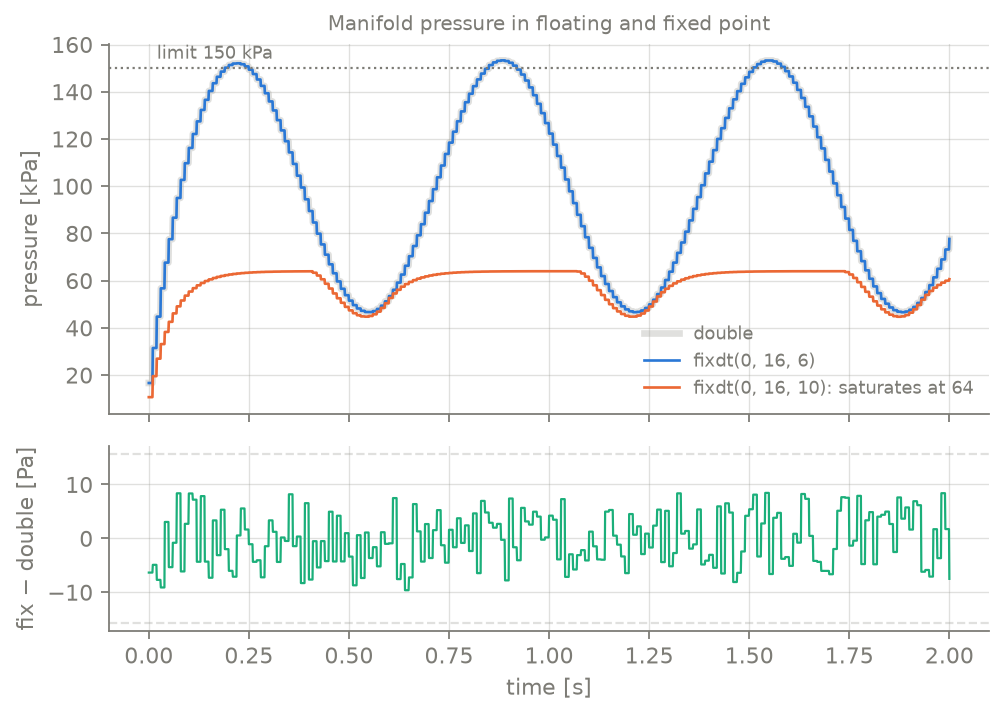
The true pressure swings between 40 and 160 kPa. The fixed-point chain follows the double chain within
0.010 kPa (10 Pa), less than one resolution step: every value it produces is a multiple of 1/64 kPa (turn on
View ▸ Data Types to see the types on the wires). That is far below the sensor's own accuracy, so the
16-bit format is a good choice.
What can go wrong: the range
More fraction bits mean finer resolution but a smaller range. fixdt(0, 16, 10) has a resolution of 1/1024 kPa
but can only hold values up to 64 kPa. Select scale_fix, set output_type to fixdt(0, 16, 10) and run:
the pressure saturates at 64 kPa, and the over-pressure check never fires, although the real pressure
reaches 160 kPa. Nothing crashes and no error is reported: this is why fixed-point formats are chosen from the
signal's physical range, and why production code is tested with the extreme values.
Experiments
Select the scale_fix block and change its output_type in Properties:
| Try | What you will see |
|---|---|
fixdt(0, 16, 2) |
resolution 0.25 kPa: the error grows to 0.15 kPa, still small for a pressure sensor |
uint8 |
whole kPa only (and at most 255): the error is up to 0.7 kPa, visible as steps |
fixdt(0, 16, 9) |
the range ends at 128 kPa: the signal is cut off there and the check never fires |
fixdt(0, 16, 10) |
saturates at 64 kPa, as above |
See Data types and fixed point for the rules (rounding, overflow, how types are inherited) and the code-generation tutorial for turning such a chain into C.
Next
Next in this topic: Exchanging models with FMI. Or pick another one from the tutorial overview.