Tutorial: Idle speed control
| You will learn | how an ECU holds the idle speed: a mean-value engine model, a PI controller with feed-forward, requirements as test cases, C code |
| Before this | Your first model: a cruise control |
| Level and time | beginner, about 45 minutes |
| Follow along | start the editor (uv run nervus), File ▸ Open examples/idle_speed_control.nervus, press ▶ and double-click the scopes; the figures below come from the same model |
| Topic | Powertrain and engine control ▸ Engine management (all tutorials) |
This tutorial walks through examples/idle_speed_control.py. It's a complete engine-control loop: a
physical engine model, an ECU function that holds the idle speed, a calibration, requirement tests, and C
code. Open examples/idle_speed_control.nervus in the editor to follow along.
1. The plant: a mean-value engine model
A mean-value engine model (MVEM) averages over the engine cycle. It ignores individual combustion events but captures how air, pressure and speed evolve, which is exactly what idle control needs.
| Part | Equation | Block(s) |
|---|---|---|
| Throttle flow | \(\dot m_{th} = C_d A(\alpha) \frac{p_{amb}}{\sqrt{R T}} \Psi\left(\frac{p_{im}}{p_{amb}}\right)\) | throttle_flow (Python Function) |
| Intake manifold | \(\dot p_{im} = \frac{R T}{V_{im}} (\dot m_{th} - \dot m_{cyl})\) | manifold_net_flow, R_T_over_V, p_intake |
| Cylinder air flow | \(\dot m_{cyl} = \eta_{vol} \frac{p_{im} V_d \omega}{4 \pi R T}\) | cylinder_flow |
| Torque | \(T = \eta_{th} Q_{LHV} \frac{\dot m_{cyl}/14.7}{\omega} - (T_{f0} + c_f \omega) - T_{load}\) | net_torque |
| Crankshaft | \(J \dot\omega = T\) | 1/J, omega |
\(\Psi\) is the compressible-flow function. Below a pressure ratio of 0.528 the flow is choked (sonic) and no longer depends on the manifold pressure. At idle the throttle is almost closed and the manifold is at about 20 kPa, so the engine runs on choked flow: the air flow depends on the throttle angle only.
The manifold acts as a delay: when the throttle opens, the pressure (and therefore the torque) needs roughly a quarter of a second to follow. That makes idle control hard.
2. The ECU function
Double-click the ECU subsystem. It does what the idle speed controller in a real ECU does, every 10 ms:
- sample the engine speed (
rpm_sample, a Zero-Order Hold atTs = 0.01), - compute the speed error to the target
rpm_idle, - run a discrete PI controller with clamping anti-windup (
idle_pi), - add a base throttle opening
alpha_base(feed-forward for the nominal idle air demand), - add
alpha_acwhen the air-conditioning is requested (AC feed-forward).
All gains are workspace variables, so they are calibration parameters with units and limits, and appear in the generated A2L file.
3. Why feed-forward?
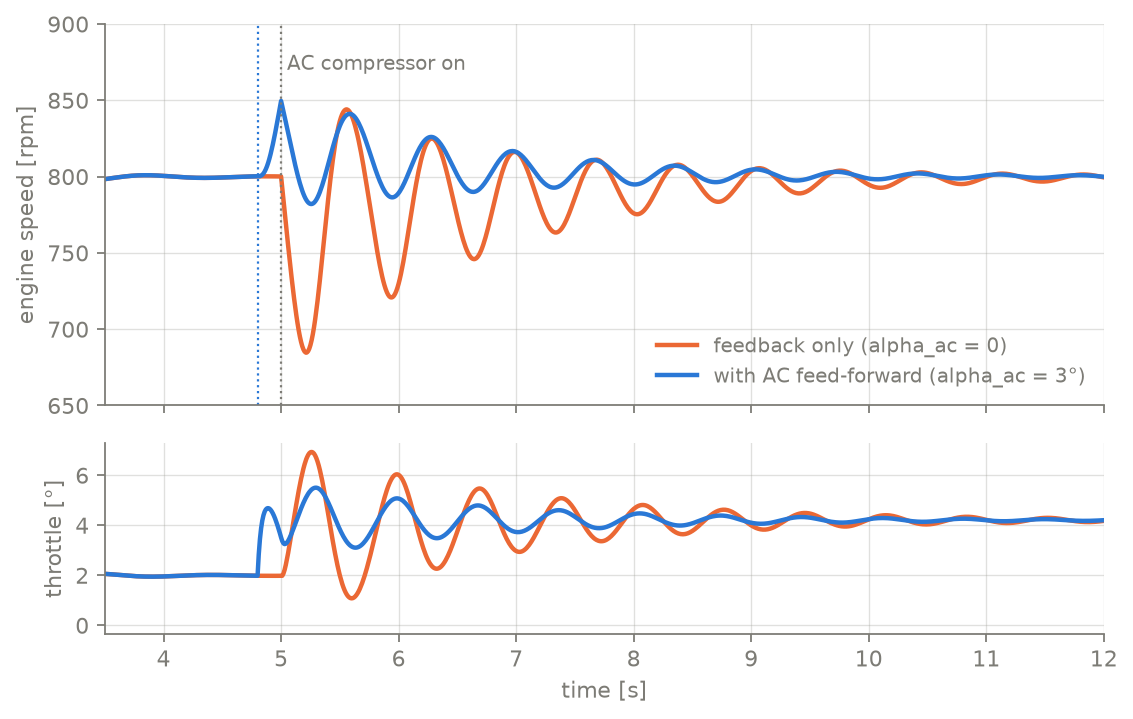
At t = 5 s the AC compressor adds 12 N·m of load. Feedback alone can only react once the speed has already
dropped, and the manifold delay makes the reaction slow, so the speed falls to about 685 rpm. Production ECUs
receive the AC request about 200 ms before the compressor clutch engages, and open the throttle in
advance. With alpha_ac = 3° the dip shrinks to about 775 rpm:
Try it: set alpha_ac to 0 in the Model Workspace and run again, or compare both in the Data Inspector.
4. Requirements as test cases
The model stores three test cases (Test Manager → Run all):
| Test case | Checks |
|---|---|
| AC compressor on at 5 s | 780–820 rpm before the event, never below 750 rpm, 780–820 rpm again after 9 s |
| AC compressor on, no feed-forward | alpha_ac = 0: between 600 and 900 rpm (no stall) |
| higher idle target | rpm_idle = 1000: settles at 1000 ± 15 rpm |
5. C code for the ECU
Select the ECU subsystem and press Code → Generate C Code. Run SIL check compiles the controller and
compares it with the model step by step. The engine model stays in simulation; only the controller becomes
code.
Things to try
To try one: change the value in the Model Workspace tab (double-click it), or for a block parameter select the block and edit it in Properties; press ▶ and compare with the previous run in the Data Inspector (Ctrl+I). Ctrl+Z undoes the change.
- Make the controller faster: increase
Kp_idle. When does it start to oscillate, and why does the manifold delay limit it? - Replace the PI controller's feed-forward with a 2-D lookup table of base opening over coolant temperature and target speed. Real ECUs need more air when the engine is cold.
- Add a State Chart that switches between crank, idle and drive modes and only enables idle control in idle.
Next
Next in this topic: Lambda control and fuel trims. Or pick another one from the tutorial overview.