Tutorial: Tyre slip and traction control
| You will learn | tyre slip and Pacejka's magic formula, wheel and vehicle dynamics, a traction control ECU on dry, wet and snowy roads |
| Before this | Your first model: a cruise control |
| Level and time | intermediate, about 30 minutes |
| Follow along | start the editor (uv run nervus), File ▸ Open examples/traction_control.nervus, press ▶ and double-click the scopes; the figures below come from the same model |
| Topic | Vehicle dynamics and energy ▸ Chassis control (all tutorials) |
This tutorial follows examples/traction_control.py: a car launching at full throttle on dry, wet and snowy
roads, and a traction control (TCS) ECU that keeps the driven wheels from spinning.
uv run python examples/traction_control.py
Slip and the magic formula
A tyre transmits force only through slip: the driven wheel turns a little faster than the car moves,
The force rises steeply with slip, peaks at about 10 %, then falls slowly; a spinning tyre also loses its side grip, so the car can no longer be steered. Pacejka's magic formula fits this curve:
with B = 10, C = 1.9, E = 0.97 here, and the road's friction μ (dry 1.0, wet 0.5, snow 0.2) scaling it.
The car: the engine torque at the wheels turns the driven wheels (their inertia includes the engine's, reflected through 1st gear: 30 kg·m²); the tyre force pushes the car and brakes the wheels.
Traction control
Every 10 ms the TCS ECU compares the driven wheels' speed with the non-driven wheels' (which turn with the car) and computes the slip. Above the 10 % target, a PI controller reduces the engine torque (0 = none, 1 = all).
| Road | TCS off | TCS on |
|---|---|---|
| dry (μ = 1.0) | 8 % slip, 0-50 km/h in 2.7 s | the same: the tyres grip, TCS does nothing |
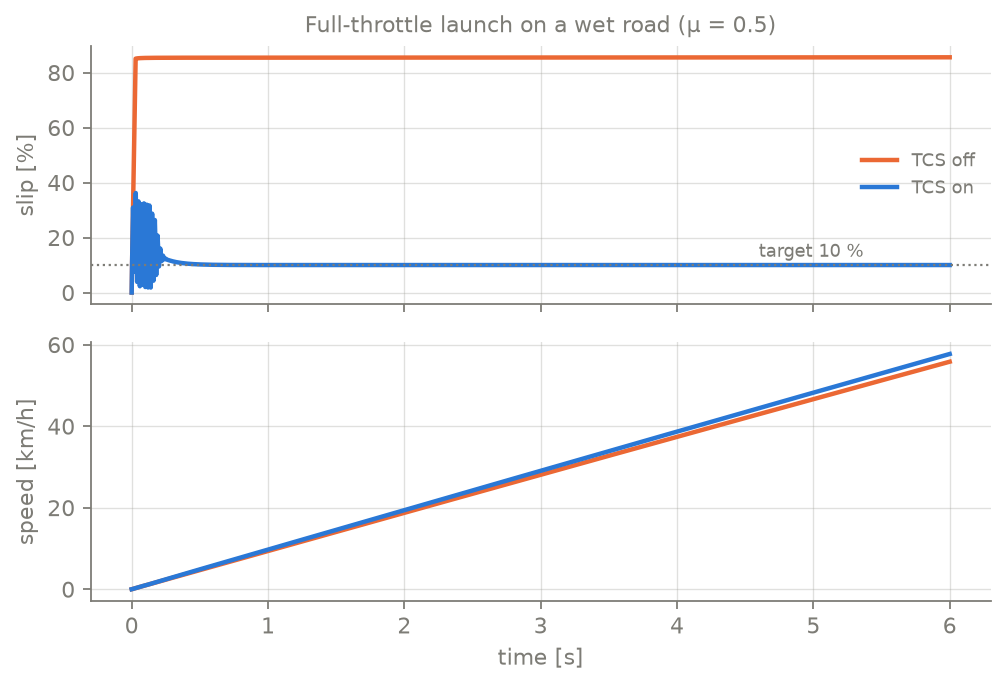
| wet (μ = 0.5) | the wheels spin at 86 % slip, 0-50 in 5.4 s | 10 % slip, 0-50 in 5.2 s |
| snow (μ = 0.2) | 96 % slip | 10 % slip (13 % at the start) |
On the wet road the car is only a little faster with TCS (the magic formula's force falls slowly past its peak), but its wheels keep their side grip: that is the main point of traction control. In the first 0.2 s the controller oscillates: at walking pace the slip changes very fast compared with the 10 ms task, and real systems use the brakes and an engine torque model for the start.
Experiments
To try one: change the value in the Model Workspace tab (double-click it), or for a block parameter select the block and edit it in Properties; press ▶ and compare with the previous run in the Data Inspector (Ctrl+I). Ctrl+Z undoes the change.
| Try | What you will see |
|---|---|
slip_target = 0.2 |
20 % slip and a little faster (60 instead of 58 km/h after 6 s): this tyre's peak is broad |
J_wheels = 2.5 (the wheels alone) |
the wheels spin up much faster than the 10 ms task: slip peaks at 67 % |
mu_road = 0.2, T_wheel_max = 500, tcs_enable = 0 |
below the 550 N·m the snowy tyres can carry: little slip even without TCS |
Next
Next in this topic: Anti-lock braking (ABS). Or pick another one from the tutorial overview.