Tutorial: On-board diagnostics and trouble codes
| You will learn | diagnostic monitors: debouncing, enable conditions, pending and confirmed codes, two-trip detection, the MIL, readiness; reading the codes with an OBD tool |
| Before this | Engine operating modes; read OBD-II live data first |
| Level and time | intermediate, about 35 minutes |
| Follow along | start the editor (uv run nervus), File ▸ Open examples/obd_ecu.nervus, press ▶ and double-click the scopes; the figures below come from the same model |
| Topic | ECU software, communication and diagnostics ▸ Diagnostics (all tutorials) |
Every engine ECU watches itself: monitors test the misfire rate, the fuel trims, the catalyst, the sensors, and
store a diagnostic trouble code (DTC) and switch on the check-engine lamp (MIL) when a test fails. A
workshop reads the codes over the OBD-II port. examples/obd_ecu.py is such an ECU with two monitors, and it can
answer a real OBD tool.
uv run python examples/obd_ecu.py
The monitors
| Code | Monitor | Raw test | Enable condition |
|---|---|---|---|
| P0302 | cylinder 2 misfire | misfires in a counting window ≥ misfire_limit |
coolant above 40 °C (a cold engine misfires more) |
| P0171 | system too lean | long-term fuel trim ≥ ltft_limit (+20 %) |
always |
From 20 s, cylinder 2 misfires. The fuel trim stays at +4 %, so P0171 passes. A key cycle (key off and on) happens every 30 s.
Each monitor is a Diagnostic Monitor block, which implements what the OBD rules require:
- debouncing: a counter goes up while the raw test fails and down while it passes; only at the threshold (10 samples of 0.1 s) is the test failed, so a glitch does not set a code;
- pending: the first failure stores the code as pending at once;
- confirmed and MIL: failing in two key cycles in a row ("two-trip detection") confirms the code and switches on the MIL; three cycles without a failure switch it off again (the code stays stored);
- readiness: the monitor reports complete once it has run, passed or failed. An inspection station checks that the monitors are ready before it trusts "no codes".
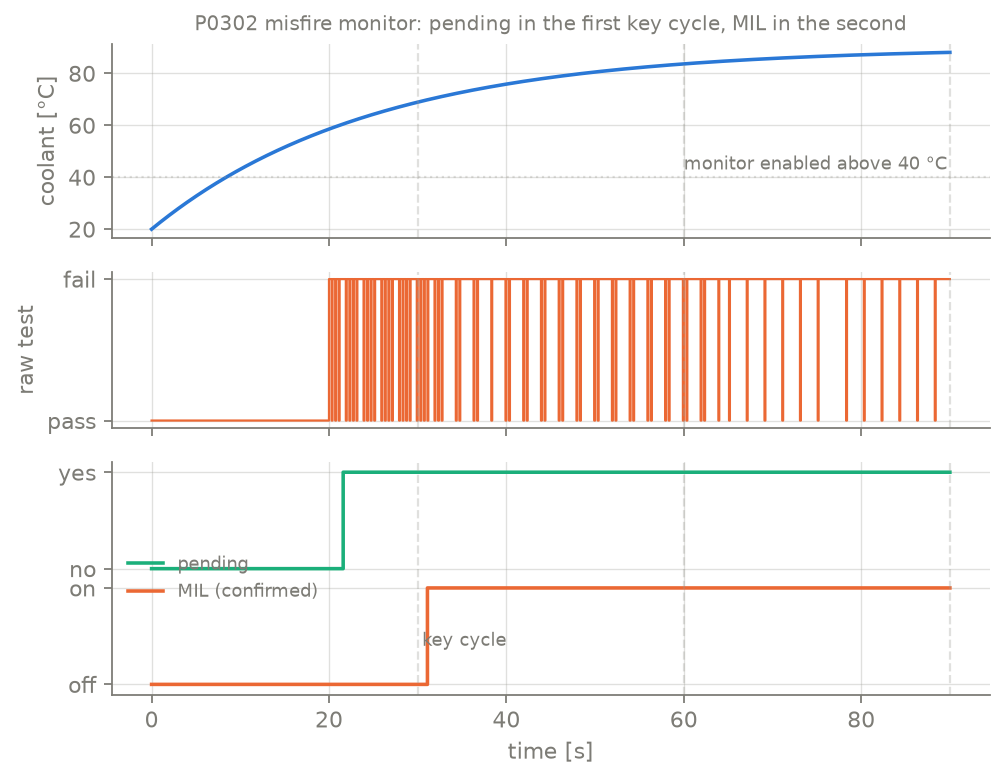
Follow the scenario
Open examples/obd_ecu.nervus and run it (90 s). The engine is warm (40 °C) at 8.5 s; the misfire monitor then
runs and is ready at 9.5 s (it has completed without a failure). The misfire starts at 20 s: after 10 failed
samples the code is pending at 21.6 s. At the key cycle at 30 s the code fails again in the new cycle: it is
confirmed and the MIL comes on at 31.1 s. The Test Manager has the same story as two test cases; run
them with Ctrl+T.
Read the codes with an OBD tool
The OBD Responder block publishes four PIDs (rpm, speed, coolant temperature, load) and both codes. Run the model in real time as a simulated car with an ELM327 adapter on a serial port (macOS and Linux):
uv run python -m nervus.obd simulate examples/obd_ecu.nervus
#   ECU 'ecu': ELM327 on /dev/ttys007
uv run python -m nervus.obd dtc --port /dev/ttys007        # in another terminal, after 31 s
The dtc command shows P0302 (Cylinder 2 misfire detected) as stored and pending, and the MIL. Any OBD
program that talks to an ELM327 can connect to that port, also one that clears the codes (mode 04): the
responder's clear output then resets the monitors, and their readiness drops back to not complete, exactly
as after clearing codes in a real car. See OBD-II live data.
Experiments
| Try | What you will see |
|---|---|
coolant_tau = 100 (slow warm-up) |
the monitor is enabled only at 35 s: the code is pending at 35.1 s and the MIL comes on in the third cycle (60.9 s) |
misfire_limit = 1.5 |
the raw test can never fail: no code, but the monitor reports ready. A wrong threshold hides the fault and still passes the inspection: why monitors are calibrated and tested against faults |
| threshold = 30 on P0302_monitor | slower debouncing (the raw test fails in only 75 % of the windows, so the counter also goes down): pending at 25.0 s instead of 21.6 s |
Next
Next in this topic: Sensor fault diagnosis and substitute values. Or pick another one from the tutorial overview.