Tutorial: Position control of a mass-spring-damper
| You will learn | what the P, I and D terms do, natural frequency and damping ratio, steady-state error, actuator limits and anti-windup |
| Before this | Your first model: a cruise control |
| Level and time | beginner, about 30 minutes |
| Follow along | start the editor (uv run nervus), File ▸ Open examples/mass_spring_damper_pid.nervus, press ▶ and double-click the scopes; the figures below come from the same model |
| Topic | Control engineering ▸ Classic lab experiments (all tutorials) |
examples/mass_spring_damper_pid.py is the first experiment of many control lab courses: a mass on a spring,
pushed by a force actuator, and a PID controller that moves it to a reference position. You will design the
controller in the classic order, P, then PD, then PID, and see what each term does.
uv run python examples/mass_spring_damper_pid.py
The plant
A mass \(m\) on a spring \(k\) with viscous damping \(c\), pushed by a force \(F\):
With \(m = 1\) kg, \(c = 0.5\) N·s/m and \(k = 2\) N/m the open plant has the natural frequency \(\omega_n = \sqrt{k/m} = 1.41\) rad/s and the damping ratio \(\zeta = c / (2\sqrt{km}) = 0.18\): left alone it oscillates for a long time. In the model the equation is two Integrators (acceleration → velocity → position) with the spring and damper as feedback Gains, the way it is drawn in every textbook. The actuator is limited to ±50 N (the PID block's upper and lower).
Step 1: P control
In the Model Workspace set Ki = 0 and Kd = 0, then press ▶ and open the scope. A P controller
acts like an extra spring: the closed loop has the stiffness \(k + K_p\), so
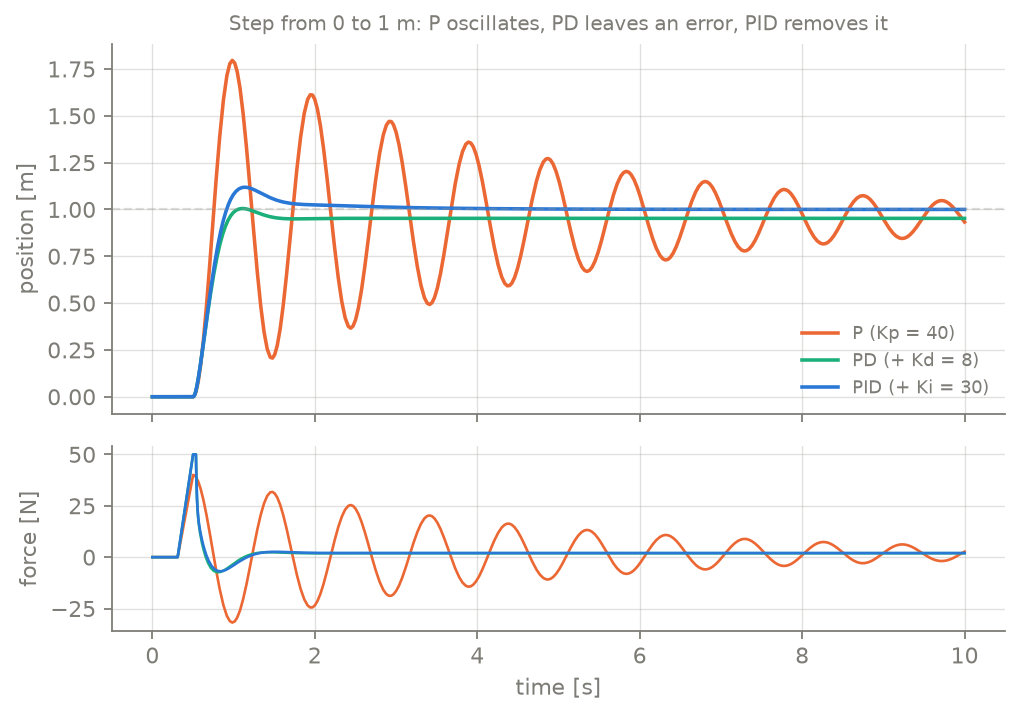
The mass shoots to 1.8 m and rings for many seconds around 0.952 m. A stiffer controller makes the error smaller but the oscillation worse: P alone cannot do both.
Step 2: PD control
Set Kd = 8. The derivative term acts like an extra damper: \(\zeta = (c + K_d) / (2\sqrt{m(k+K_p)}) = 0.66\).
The overshoot drops to 5.5 % and the mass is settled within 1.4 s, but still at 0.952 m: the D term does
nothing at standstill, so the steady-state error stays. The step makes the D term kick: the force jumps to the
50 N limit for a moment.
Step 3: PID control
Set Ki = 30. The integral term keeps pushing while there is any error, so the mass ends exactly at 1 m.
The price is a little more overshoot (12 %); the response settles within 2 % in 2.3 s.
| Controller | Highest position | Final position | Settled (2 %) |
|---|---|---|---|
| P (Kp = 40) | 1.80 m | 0.952 m (still ringing at 10 s) | > 10 s |
| PD (Kd = 8) | 1.00 m | 0.952 m | 1.4 s |
| PID (Ki = 30) | 1.12 m | 1.000 m | 2.3 s |
The controller uses clamping anti-windup: while the force is at its limit, the integrator stops. With
back-calculation anti-windup and Ki = 0, the integrator would still collect the saturation correction and
leave a permanent offset (Simulink behaves the same way), so clamping is the right choice for a lab where the I
term is switched off and on.
Check it by hand, then with the tuner
The PD loop's characteristic equation is \(m s^2 + (c + K_d) s + (k + K_p) = 0\), that is
\(s^2 + 8.5 s + 42 = 0\), with the poles \(-4.25 \pm 4.9j\): \(\omega_n = 6.5\) rad/s and \(\zeta = 0.66\), as in step 2.
For a systematic design open Analysis ▸ Linear Analysis ▸ PID Tuning, choose the block pid and a phase
margin, and press Tune: it designs the gains from the plant the controller sees (see
Linear analysis). Copy its gains into the workspace and compare its step response with
yours in the Data Inspector: a large phase margin gives a calm but slower response.
Experiments
| Try | What you will see |
|---|---|
Kp = 100 (PID) |
faster (settled in 1.3 s) but 20 % overshoot |
Ki = 100 |
the error disappears faster, but the overshoot grows to 33 % |
m = 3 (a heavier mass, same gains) |
42 % overshoot: gains are tuned for one plant |
Kd = 20 |
more damping in the PD part, but the I term still overshoots (13 %) and settling takes longer (4.5 s) |
Next
Next in this topic: DC motor speed and position control. Or pick another one from the tutorial overview.